
How Handheld 3D Scanning Enables Faster, More Confident Decisions
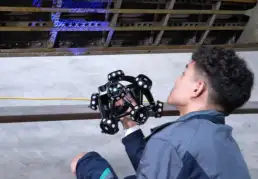
At Southern Manufacturing, one theme surfaced repeatedly in conversations with engineering and operations leaders. Many organisations were not struggling with capability or expertise, but with certainty. Decisions were often being made without complete or reliable data about the physical reality of the parts or processes involved.
Reverse engineering and benchmarking are not new disciplines. Manufacturers have always needed ways to understand existing components, validate performance, and improve designs. What has changed is the expectation around speed. Modern manufacturing environments demand faster decisions, shorter development cycles, and greater accountability for risk.
Handheld 3D scanning is increasingly playing a role in meeting these expectations. Not by replacing engineering judgement, but by enabling faster access to accurate, usable evidence. For decision-makers, the conversation is no longer centred on whether data can be captured, but how quickly physical reality can be translated into information that supports confident action.
The Traditional Challenge: Decisions Without Evidence
Historically, reverse engineering has often been a time-consuming and uncertain process. Manual measurement and reconstruction required significant engineering effort before usable CAD data could even exist, and accuracy was frequently confirmed only after several iterations. During this period, teams were forced to move forward based on assumptions rather than verified information.
Benchmarking presented similar challenges. Measurement was typically limited to specific features or sample points, making it difficult to understand how variation behaved across an entire surface or assembly. The consequences were rarely described as measurement problems. Instead, they appeared as delayed production decisions, extended engineering cycles, or uncertainty around whether issues originated from design intent, tooling wear, or process variation.
For leadership teams, the real cost was not measurement itself, but the time and risk associated with operating without clear evidence.
What Handheld 3D Scanning Changes
Handheld scanning changes the dynamic by introducing flexibility into the measurement process. Rather than requiring parts to be transported to a controlled measurement environment, data capture can take place directly where the component exists. This makes it possible to digitise complex geometries quickly, even within real production environments or on large assemblies.
More importantly, handheld scanning provides full-field data rather than isolated measurement points. This allows teams to understand not only where deviation exists, but how it behaves across the entire surface and whether it has functional significance. Engineering discussions become grounded in shared visual evidence rather than interpretation.
For decision-makers, the value lies less in speed alone and more in context. Faster data capture enables earlier conversations, clearer alignment between departments, and decisions that are supported by evidence rather than assumption.
Reverse Engineering: From Physical Part to Usable Data
In many organisations, reverse engineering begins as a reactive necessity. Legacy equipment remains in operation long after original drawings have been lost, suppliers change, or components become obsolete. In these situations, the physical part itself becomes the only reliable reference.
Handheld scanning allows that reference to be captured quickly and converted into digital data that engineering teams can immediately work from. Instead of manually recreating geometry, engineers begin with an accurate representation of the existing component, reducing the number of iterations required to reach a usable model.
The impact is typically felt in three areas:
1. Reduced Engineering Lead Time
Instead of manually recreating geometry, engineers start with accurate scan data, accelerating CAD reconstruction and reducing iteration cycles.
2. Lower Risk in Replacement Manufacturing
Teams can validate that recreated parts match functional requirements before committing to production.
3. Preservation of Critical Assets
Digitising legacy components creates a long-term digital record, reducing future dependency on physical samples.
For directors, this shifts reverse engineering from a reactive process to a strategic capability.
Benchmarking: Understanding Performance Beyond Pass or Fail
As supply chains become more complex and performance expectations increase, benchmarking has taken on a more strategic role. Inspection alone can confirm whether a part meets tolerance, but it rarely explains why variation occurs or how it evolves over time.
With full-surface scan data, manufacturers gain a clearer understanding of how components differ from nominal design or from one another. This allows teams to evaluate supplier variation, monitor wear or deformation, and compare design iterations with greater confidence. Rather than relying solely on pass-or-fail outcomes, benchmarking becomes a tool for insight.
At a leadership level, this enables more informed decisions around supplier selection, process improvement, and design optimisation. Measurement data moves beyond quality control and begins to inform operational and commercial strategy.
Speed Enables Earlier, Better Decisions
Handheld scanning is often associated with speed, but the real advantage lies in what that speed enables. When evidence can be captured quickly, issues can be identified earlier in the production or development cycle. Engineering and production teams are able to align around the same information sooner, reducing the likelihood of costly late-stage changes.
In practice, this shortens feedback loops across the organisation. Conversations that might previously have taken weeks of investigation can begin immediately, supported by visual and measurable data. The outcome is not simply faster measurement, but faster organisational alignment.
The outcome is not simply faster measurement – it’s faster alignment across the business.
Where Handheld Scanning Fits Within a Measurement Strategy
Handheld scanning is not intended to replace high-accuracy metrology systems. Instead, it fills an important gap within a modern measurement strategy by enabling rapid evidence gathering and flexible investigation. It allows teams to understand problems earlier, decide when higher-accuracy inspection is required, and apply the appropriate level of measurement to the decision being made.
Organisations that see the greatest value tend to view scanning not as a standalone technology, but as part of a broader workflow that connects investigation, validation, and inspection. In this context, measurement becomes a decision-support tool rather than a final-stage verification step.
Turning Data Into Decisions
At director level, the conversation is rarely about scanning technology itself.
It’s about reducing uncertainty.
Reverse engineering and benchmarking both exist to answer the same question:
Do we have enough reliable information to move forward confidently?
Handheld 3D scanning gives manufacturers a faster way to reach that point by turning physical reality into usable data, and data into decisions.