
Measuring large parts shouldn’t require complex setups, lengthy prep, or dedicated inspection space. Here’s how manufacturers are simplifying large-part inspection without slowing everything else down.
Why Large-Part Inspection Becomes a Bottleneck
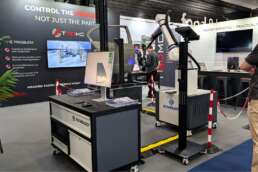
At MACH, conversations around large-part measurement all seemed to land in the same place.
It’s not that teams don’t have a way to measure large components. It’s that the process is often far more complicated than it needs to be.
Inspection becomes something that requires planning. Parts need to be moved, positioned, sometimes even prepared before measurement can begin. In some cases, additional fixtures are required just to make measurement possible. All of this adds time, introduces friction, and ultimately slows down the wider production process.
For many teams, large-part inspection isn’t just a step in the workflow—it’s a constraint.
The Hidden Complexity Behind Traditional Methods
Traditional approaches to large-part inspection often come with a level of complexity that’s simply accepted as part of the job.
That might include:
- Extensive fixturing to hold parts in place
- Surface preparation, such as spraying or marking
- Long setup times before measurement can even begin
- Dedicated spaces or equipment that limit flexibility
Individually, each of these steps might seem manageable. But together, they create a process that is slow, resource-heavy, and difficult to scale.
At MACH, it was clear that many teams are starting to question whether all of that complexity is actually necessary.
What We Heard at MACH
A consistent theme from conversations was a desire for something simpler.
Not necessarily more advanced. Not more features. Just a more straightforward way to get reliable measurement data from large parts without disrupting everything else around it.
There was a strong response to solutions that were:
- Easy to set up
- Quick to deploy
- Flexible enough to work across different parts
- Able to deliver results without heavy preparation
In other words, the focus has shifted from capability alone to practical usability.
Simplifying the Process Without Compromising Results
The shift towards automated 3D scanning for large-part inspection is largely driven by this need for simplicity.
Instead of building complex setups around the part, the process becomes far more flexible. Measurement can be carried out with minimal preparation, reducing the need for fixtures or surface treatment in many cases.
This has a direct impact on how quickly inspection can take place. Parts no longer need to be routed through a specific environment or scheduled around limited equipment. Instead, measurement becomes something that can happen more naturally within the flow of production.
The result is not just faster inspection, but a process that feels easier to manage.
What a Simpler Large-Part Inspection Workflow Can Look Like
For larger components, the opportunity isn’t just to measure faster — it’s to remove the unnecessary steps that make inspection difficult to manage in the first place.
With an automated 3D scanning approach, large parts can be measured with significantly less manual preparation. Rather than building complex fixtures around the part or moving components into a fixed inspection environment, the measurement process can be designed around the workflow itself.
In practice, this might mean using an automated scanning system to capture full surface data with minimal setup, reducing the need for spraying, targets, or repeated repositioning. For parts that are difficult to fixture or move, this can make inspection far easier to integrate into production.
The result is a more flexible workflow: load the part, run the scan, generate the inspection data, and move on to the next job with fewer manual steps in between.
This is where large-part inspection becomes much more practical. The aim isn’t to add more technology for the sake of it — it’s to remove the friction that makes measurement slow, difficult, or disruptive.
Reducing Setup Time Changes Everything
One of the biggest gains comes from reducing setup time.
In traditional workflows, setup can often take as long—or longer—than the measurement itself. Positioning the part, preparing the surface, configuring the system… all of this adds up.
By removing or significantly reducing these steps, teams are able to move much more quickly from one job to the next. Inspection becomes less of an interruption and more of an integrated part of the process.
This is particularly valuable in environments where part sizes vary or where flexibility is important.
Making Large-Part Measurement More Flexible
Another key benefit is flexibility.
At MACH, there was clear interest in solutions that could handle a range of part sizes and geometries without requiring a complete reset each time. The ability to move between jobs without complex reconfiguration makes a significant difference in day-to-day operations.
This kind of flexibility also opens up new possibilities. Instead of being limited by the constraints of a traditional setup, teams can measure larger or more complex components with fewer barriers in place.
Over time, this reduces reliance on rigid processes and allows inspection to adapt more easily to changing production demands.
A More Practical Approach to Large-Part Inspection
What’s becoming increasingly clear is that large-part inspection doesn’t need to be as complex as it has traditionally been.
By focusing on reducing setup, simplifying workflows, and removing unnecessary preparation steps, manufacturers are finding more practical ways to approach measurement.
This doesn’t mean compromising on accuracy or capability. It simply means achieving the same outcomes in a way that is faster, more efficient, and easier to manage.
Final Thought
Large-part inspection should support production—not slow it down.
At T3DMC, we help manufacturers identify where automated 3D scanning can reduce setup, simplify inspection and make large-part measurement more practical within their existing workflow.
If your current process involves complex setup, long preparation times, or limited flexibility, there’s likely a more practical way to approach it.
If that’s something you’re looking to improve, it’s worth exploring how a simpler, more flexible measurement approach could fit into your workflow.