
If inspection is taking hours while production keeps moving, you don’t have a measurement problem—you have a bottleneck. Here’s how manufacturers are fixing it.
When Inspection Can’t Keep Up
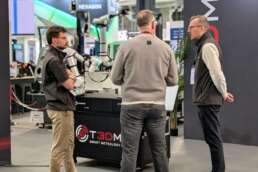
At MACH, one of the most common frustrations we heard wasn’t about accuracy or capability—it was about time.
Parts were being produced faster than they could be inspected. Measurement programs were taking hours to complete. And as a result, inspection was becoming the slowest step in the entire process.
That creates a fundamental mismatch.
Production moves forward. Inspection lags behind. And somewhere in between, delays start to build. At that point, it’s not just an inspection issue—it’s a throughput issue.
The Reality of Inspection Bottlenecks
Bottlenecks don’t always show up as obvious failures. More often, they build quietly over time:
A queue of parts waiting to be measured.
Operators working around limited inspection capacity.
Decisions being delayed because results aren’t ready.
Individually, these might seem manageable. But together, they create friction across the entire workflow. What starts as a small delay in inspection quickly impacts delivery times, production planning, and overall efficiency.
What We Heard at MACH
These weren’t isolated cases. Across multiple conversations, teams described similar challenges:
- Waiting hours for inspection results
- Struggling to keep up with increasing production volumes
- Relying on a limited number of systems to handle growing workloads
In many cases, inspection had become the limiting factor—not production itself. That shift is important.
Because once inspection becomes the bottleneck, improving production speed alone doesn’t solve the problem. It often makes it worse.
Why Faster Production Doesn’t Fix It
There’s a natural instinct to focus on improving production efficiency—faster machining, better workflows, increased output. But if inspection can’t keep up, those improvements don’t translate into real gains. Instead, they increase pressure on an already constrained part of the process.
More parts are produced, but they still need to be measured. Queues grow longer. Delays increase. And the gap between production and inspection widens. This is where many teams start to feel stuck.
Rethinking the Bottleneck
Breaking an inspection bottleneck doesn’t always mean replacing existing systems. At MACH, the more effective conversations focused on rethinking how inspection capacity is created. Instead of relying on a single system to handle everything, teams are starting to look at how different technologies can work together to increase throughput.
This might involve:
- Offloading repeatable or high-volume measurements to faster systems
- Reducing the time spent on non-critical features
- Introducing more flexible measurement approaches alongside existing methods
The goal isn’t to change everything. It’s to remove pressure from the part of the process that’s slowing everything down.
Creating Flow Instead of Queues
When inspection capacity increases, the impact is immediate. Parts move through the process more smoothly. Queues begin to disappear. Decisions can be made faster because data is available when it’s needed. What was previously a stop-start workflow becomes more continuous.
This doesn’t just improve inspection—it improves the entire production process because once the bottleneck is removed, everything upstream and downstream becomes more efficient.
A More Balanced Approach to Inspection
One of the key takeaways from MACH was that inspection doesn’t need to sit in one place or rely on one method. By introducing more flexible, faster measurement approaches alongside existing systems, teams are able to create a more balanced workflow.
High-precision tasks can still be handled where accuracy is critical, while faster methods take care of the volume. This balance is what allows inspection to scale with production, rather than holding it back.
A Practical Way Forward
If you’re waiting hours for inspection results, it’s worth stepping back and looking at the bigger picture.
Where is time being lost?
What’s causing delays to build?
And which parts of the process are creating the most pressure?
In many cases, the issue isn’t a lack of capability—it’s a lack of capacity in the right places. Once that’s addressed, the bottleneck becomes much easier to remove.
Final Thought
Bottlenecks don’t just slow down inspection—they slow down everything. If production is moving faster than your measurement process can support, the solution isn’t to push harder. It’s to rebalance the system.
If that’s a challenge you’re facing, it’s worth exploring how a more flexible approach to inspection could help keep everything moving.