
When evaluating 3D measurement solutions, production teams often view the decision as a strict choice between manual hand scanners and fully automated inspection cells. However, treating these technologies as mutually exclusive limits your operational potential.
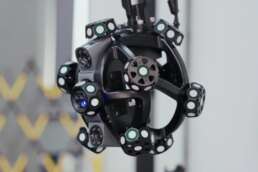
Manufacturing leaders face a constant balancing act. You need to maximise throughput while maintaining flawless quality control. Integrating both handheld 3D scanners and automated measurement systems into the same production line creates a highly adaptable, robust quality assurance process. This hybrid approach allows you to address diverse manufacturing challenges without compromising on speed or precision.
This post will outline exactly why you should consider a combined measurement strategy. You will learn how automated systems provide relentless repeatability, why handheld scanners offer crucial flexibility, and how combining the two delivers comprehensive quality control for modern manufacturing environments.
The Manufacturing Measurement Dilemma
Quality control requirements are becoming increasingly complex. Tolerances are tighter, part geometries are more intricate, and customer expectations for zero-defect deliveries are the baseline standard. To meet these demands, engineering teams require precise, reliable metrology data.
Historically, companies relied heavily on traditional Coordinate Measuring Machines (CMMs) or basic manual gauges. While accurate, these methods often create severe inspection bottlenecks. The modern answer lies in advanced 3D scanning technologies, which capture millions of data points in seconds to generate a complete digital twin of a physical component.
The question then becomes how to deploy this technology. Should you invest in a fully automated robotic scanning cell, or equip your team with portable handheld scanners? The most successful production facilities recognise that they do not have to choose just one.
The Strengths of Automated 3D Measurement
Automated 3D measurement systems, typically involving optical scanners mounted on robotic arms, excel in high-volume, repetitive environments. They are the workhorses of the modern production line.
Relentless Repeatability and Speed
When you need to inspect hundreds of identical parts per shift, automation is the clear choice. Once an engineer programmes the inspection routine, the robotic system follows the exact same path every single time. This eliminates the variability associated with human operators. You get highly consistent, objective data that you can trust completely.
Automated cells capture full surface data in a fraction of the time it takes to manually inspect a component. This speed allows many manufacturers to move from sample-based checks to 100% inline inspection. When you measure every part, you drastically reduce the risk of non-conforming products reaching your customers.
Removing Human Error
Human error is inevitable in manual, repetitive tasks. Fatigue and momentary lapses in concentration can lead to missed features or incorrect measurements. By automating the routine inspection of standard components, you remove this risk entirely. The system operates tirelessly, ensuring your quality control standards remain uncompromisingly high across all shifts.
The Power of Handheld 3D Scanners
While automation handles routine volume, handheld 3D scanners provide something equally valuable: absolute flexibility. These portable devices place advanced metrology directly into the hands of your engineering team, allowing them to measure parts wherever they are.
Unmatched Portability and Reach
Not every inspection task can happen inside a dedicated measurement cell. Sometimes, a component is too large, too heavy, or completely immovable. Handheld scanners allow your team to take the measurement tool directly to the part, whether it sits on the shop floor, inside a CNC machine, or out in the field.
Furthermore, operators can easily manoeuvre handheld scanners to capture data in tight spaces, deep recesses, or complex internal geometries that a pre-programmed robotic arm might struggle to reach without causing a collision.
Immediate Triage and Root Cause Analysis
When a production line goes down due to a quality issue, you need answers immediately. Handheld scanners are perfect for rapid troubleshooting. An engineer can grab a scanner, walk onto the shop floor, and capture a complete 3D surface map of a defective part within minutes.
By instantly comparing this scan data against the original CAD model, the team can visualise the exact deviations via a colour map. This immediate feedback loop allows you to identify root causes—such as tool wear or thermal distortion—and implement corrective actions before the problem escalates.
The Synergy: Why Combine Both?
When you deploy both automated cells and handheld scanners on the same production line, you stop compromising. You build a quality control ecosystem capable of handling any manufacturing challenge thrown its way.
Comprehensive Quality Control
A combined approach means you use the right tool for the right job. You can route your high-volume, standard production components through the automated measurement cell for rapid, continuous verification. Meanwhile, your quality engineers use handheld scanners to inspect low-volume custom parts, conduct spot checks, or analyse complex prototypes.
This division of labour ensures your automated lines never stop running, while your quality team retains the agility to investigate anomalies without disrupting the main production flow.
Empowering Your Engineering Workforce
Using both systems optimises how you deploy your human talent. By automating the tedious, repetitive inspection of thousands of standard parts, you free up your skilled quality inspectors.
Instead of acting as manual data gatherers, your staff can focus on high-value tasks. They can use handheld scanners to solve complex engineering problems, reverse engineer legacy components, or analyse the rich data generated by the automated systems to drive continuous process improvements.
Cost-Effective Scaling and Redundancy
Investing in a massive, fully automated system to handle 100% of your diverse measurement needs is often cost-prohibitive and technically impractical. A hybrid strategy is much more cost-effective. You build targeted automated cells for your highest-volume bottlenecks and support the rest of the facility with versatile handheld units.
Additionally, this approach provides essential redundancy. If an automated cell requires maintenance or reprogramming for a new product launch, your team can seamlessly step in with handheld scanners to keep production moving. You eliminate single points of failure in your quality assurance process.
A Practical Manufacturing Scenario
Consider an aerospace manufacturer producing structural components. The facility produces hundreds of identical brackets daily, alongside a smaller number of large, highly complex fuselage panels.
Relying solely on manual inspection creates a severe backlog for the brackets. Relying solely on an automated cell means the massive fuselage panels cannot be easily inspected without building an unjustifiably expensive, room-sized robotic system.
By combining technologies, the manufacturer solves both problems. The daily run of brackets passes through a compact, automated 3D scanning cell, ensuring fast, repeatable, and 100% verified quality. Simultaneously, quality engineers use high-resolution handheld laser scanners to inspect the large fuselage panels directly on the assembly fixtures. The result is total production efficiency, zero bottlenecks, and complete confidence in the final product.
Your Next Steps at MACH 2026
Rethinking your quality control strategy requires an understanding of your specific production bottlenecks and engineering goals. The most effective measurement solutions are built around your unique needs, rather than a one-size-fits-all product pitch.
We invite you to discuss your manufacturing challenges with The 3D Measurement Company at MACH 2026. Join us from 20-24 April at the NEC Birmingham on Stand 18-610 for a practical conversation about improving your production line. Our expert team will be on hand to demonstrate how combining handheld flexibility with automated repeatability can transform your quality assurance processes, reduce scrap, and increase your profitability.
We look forward to helping you build a better, more resilient manufacturing strategy.