
It happens in production facilities every day.
Your CNC machines are running. Your assembly line is hitting targets. But batches of critical components are sitting idle—waiting for inspection.
Measurement becomes the bottleneck.
Even when parts move through, the data often doesn’t. You generate gigabytes of measurement information, yet decisions still rely on instinct. Add inconsistent results between operators, and what should be a control point becomes a source of uncertainty.
If that sounds familiar, you’re not alone.
Measurement and quality control are often the most overlooked constraints in modern manufacturing. And until they’re addressed, they quietly limit throughput, increase costs, and slow decision-making across the entire operation.
The Hidden Cost of Measurement Bottlenecks
When inspection can’t keep pace with production, the impact isn’t isolated—it spreads.
Slower throughput and idle machinery
When parts wait for verification, machines wait too. High-value equipment ends up operating at the speed of your slowest inspection process.
Rising rework and scrap
Without fast feedback, issues go unnoticed for longer. One small drift can result in dozens of non-conforming parts before it’s caught.
Delayed decision-making
When data takes hours—or days—to process, teams are forced to make calls without it. That’s when inefficiencies compound.
Audit pressure and compliance risk
Disjointed measurement processes make traceability harder, reporting slower, and audits far more stressful than they need to be.
The 3 Most Common Bottlenecks
Most measurement challenges fall into three familiar patterns.
1. Manual processes that don’t scale
Manual tools—and even traditional CMM workflows—struggle to keep up with modern production demands. Programming delays, operator dependency, and inspection queues quickly build into a backlog.
2. Data that sits in reports
Collecting accurate data isn’t the problem—using it is. When measurement results live in static reports, they don’t inform decisions, improve processes, or prevent defects.
3. Rigid workflows lacking flexibility
Production isn’t static. Your measurement strategy shouldn’t be either. If inspection only happens in one place, at one stage, with one tool, it creates unnecessary movement, delays, and risk.
What Better Actually Looks Like
When measurement supports production instead of slowing it down, the shift is immediate.
Inspection keeps pace with production
Full-surface inspections move from hours to minutes—eliminating queues and keeping processes flowing.
Data drives decisions in real time
Instead of static reports, teams work with live, visual data—enabling faster adjustments and reducing downstream issues.
Measurement adapts to the environment
Whether on the shop floor, inside a machine, or within an automated cell, inspection happens where it adds the most value.
Structuring a More Effective Measurement Approach
Improving measurement isn’t about replacing everything—it’s about removing the specific constraints holding you back.
Different challenges require different approaches.
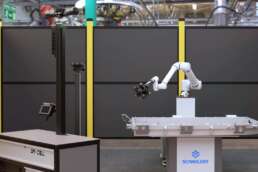
- For high-volume, repeatable inspection, automated systems like the AM-Cell C Series provide consistent, unattended measurement—keeping throughput high without increasing operator workload.
- For large, complex, or in-process components, portable solutions like NimbleTrack allow you to capture accurate data directly on the shop floor—reducing movement, downtime, and risk.
- For flexible, in-line inspection, systems like the Metrology Desk create structured, repeatable measurement points that can adapt as production demands change.
The goal isn’t to force one solution across every scenario. It’s to ensure measurement is no longer the constraint—no matter where or how it’s applied.
Take the Next Step
Measurement bottlenecks don’t always announce themselves—but they’re almost always there.
And until they’re addressed, they quietly limit how fast, efficiently, and confidently you can operate.
If you’re attending MACH, come and talk to us about where measurement is slowing you. We’ll be at Stand 18-610, 20-24 April 2026 at the NEC, Birmingham.