
For decades, the “plaster room” has been the heart of the maxillofacial prosthetics lab. It’s where artistry meets anatomy. But for the clinical teams working there, it’s also a source of constant friction – intrusive procedures, heavy physical storage, and materials that degrade over time.
At New Cross Hospital in Wolverhampton, the Oral and Maxillofacial Surgery team decided it was time to challenge the status quo.
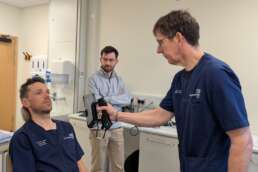
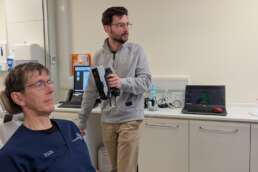
Earlier this year, Prosthetist Dave Ellis and his team, including Deputy Laboratory Manager Conrad Taylor, and Dental Technician Anna Witkowska, trialled a digital alternative to the traditional impression workflow.
Following the successful trial and completion of the necessary funding, approval and procurement process, New Cross Hospital are now on track to purchase the 3DeVOK MT. The team is currently preparing to bring the speed, usability and patient benefits demonstrated during the trial into its everyday facial prosthetics workflow.
Their experience with the 3DeVOK MT scanning system offers a roadmap for other NHS Trusts looking to balance clinical precision with patient comfort.
The Problem: The Clinical Burden of Analogue Workflows
For any prosthetics lab, the struggle isn’t just about making the prosthesis—it’s about the journey to get the data.
For the team at New Cross, the traditional workflow had three major bottlenecks:
- Patient Distress: Taking alginate impressions for facial reconstruction is invasive. For patients already dealing with trauma, post-surgical sensitivity, or anxiety, having their face covered in material is often an ordeal.
- The “Fragile Asset” Problem: Plaster moulds are heavy, brittle, and take up valuable storage space. Worse, they degrade. If a mould breaks or is lost, the patient has to go through the impression process all over again.
- The Radiology Queue: When high-quality digital data was needed, the team often had to schedule CT scans. This put them in direct competition with acute diagnostic needs, leading to scheduling delays and the high cost of using a medical scanner for non-diagnostic purposes.
The team needed a way to “digitise once, reproduce indefinitely” without relying on Radiology or distressing their patients.
Enter the 3DeVOK MT: A “Point-and-Shoot” Solution
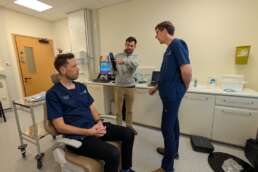
The department trialled the 3DeVOK MT, a structured light scanning system designed specifically for high-fidelity 3D capture.
Unlike generic industrial scanners that struggle with skin or hair, or complex photogrammetry rigs that require a dedicated room, the 3DeVOK MT is handheld and fast. It captures geometry and texture simultaneously, creating a digital twin of the patient’s anatomy in seconds.
During the demonstration at New Cross, the focus wasn’t on reading spec sheets. It was about answering one question: Does this actually work in a busy hospital lab?
Hands-On Validation: What the Clinical Team Found
The transition from analogue to digital can be daunting, but the feedback from Dave, Conrad, and Anna highlighted how seamless the shift can be when the technology is right.
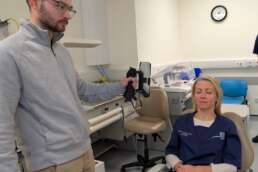
Speed is a Clinical Necessity
In a clinical setting, speed isn’t just about efficiency; it’s about data integrity. Patients move. They breathe. They blink.
The team found the scan times on the 3DeVOK MT were reduced to under a minute. “Moving from a lengthy, intrusive impression to a sixty-second non-contact scan transforms the patient experience from an ordeal into a simple consultation,” noted Dave Ellis during the trial.
Usability Wins Adoption
New technology often sits gathering dust because it requires an engineering degree to operate. The 3DeVOK MT proved to be different—and its wireless design is a genuine everyday advantage. With no trailing cables, staff aren’t limited by workstation layout or room configuration, and there’s no added trip hazard. Fewer components mean there’s less risk of damage or downtime, keeping the workflow streamlined and safe.
“Our lab has always struggled with balancing precision and efficiency, but the 3DeVOK MT changes that,” shared Conrad Taylor. “The speed of the scan and its ease of use will make a significant difference, not just for us but for the comfort and trust of our patients as well.”
The “point-and-shoot” nature of the device meant the technical staff could operate it confidently almost immediately. There was no complex calibration ritual or need for a dedicated technician just to run the machine.
Data You Can Actually Use
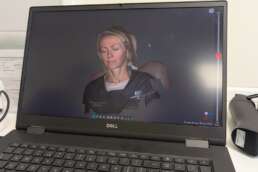
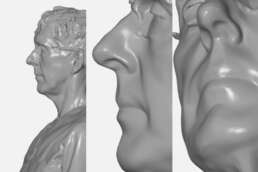
The scan data was immediately available for inspection. The system captured high-resolution texture mapping, allowing the team to visualise skin tones and anatomical landmarks clearly. This is critical for matching prostheses to the patient’s natural skin tone and texture, something a plaster mould simply cannot convey.
Beyond the Lab: Reassuring the Gatekeepers
We know that even the best clinical solutions have to pass the scrutiny of Directorate Managers. The trial at New Cross didn’t just prove the clinical case; it ticked the operational boxes required to get a business case signed off.
1. Safety First
The 3DeVOK MT uses eye-safe structured light technology. It’s non-ionising and completely safe for use on patients. This was reviewed by medical physics, confirming that—unlike X-rays or CTs—it requires no lead-lined bunkers or special safety protocols.
2. Regulatory Simplicity
Crucially, the scanner itself is not classified as a medical device. It is a data capture tool used for planning and design. This simplifies procurement and maintenance pathways significantly while remaining perfectly appropriate for clinical applications.
3. Efficiency = Cost Savings
By moving digitisation into the prosthetics lab, the team reduces their reliance on Radiology resources. Freeing up a CT scanner for acute diagnostic patients is a massive win for the wider hospital trust, making the ROI argument much easier to make.
The Verdict: A Workflow-First Approach
The demonstration at New Cross Hospital confirmed that digital scanning wasn’t simply “future technology”, but a practical solution to the clinical and operational challenges the team was experiencing.
Following the necessary funding and approvals, the hospital is now on track to purchase the 3DeVOK MT. The team will soon begin moving towards a workflow that reduces its reliance on intrusive physical impressions, fragile plaster moulds and access to Radiology resources.
For other departments facing similar challenges, New Cross Hospital’s experience demonstrates the importance of testing technology within the real clinical environment—and how that initial validation can provide the confidence needed to invest in a digital workflow.
Is your department ready to leave the plaster room behind?
If you are facing similar bottlenecks with impressions, storage, or CT access, it might be time to look at how the 3DeVOK MT can fit into your lab.
Explore the new 3DeVOK scanner bundles today to find the best fit.